Most About pages are written for nobody.
They open with a mission statement. They say the business cares about its customers. They promise quality and value, then say it again in different words. A competitor could copy the whole thing, paste it on their own site, and nothing would look out of place. That is the problem.
AI search is now part of how people find you. Someone asks a chatbot for a good roofer in McAllen. Someone reads a Google AI answer about who does commercial photography in the Valley. These tools do not reward pretty adjectives. They reward specific, verifiable facts about who you are. Generic mission copy gives them nothing to work with, so they skip it.
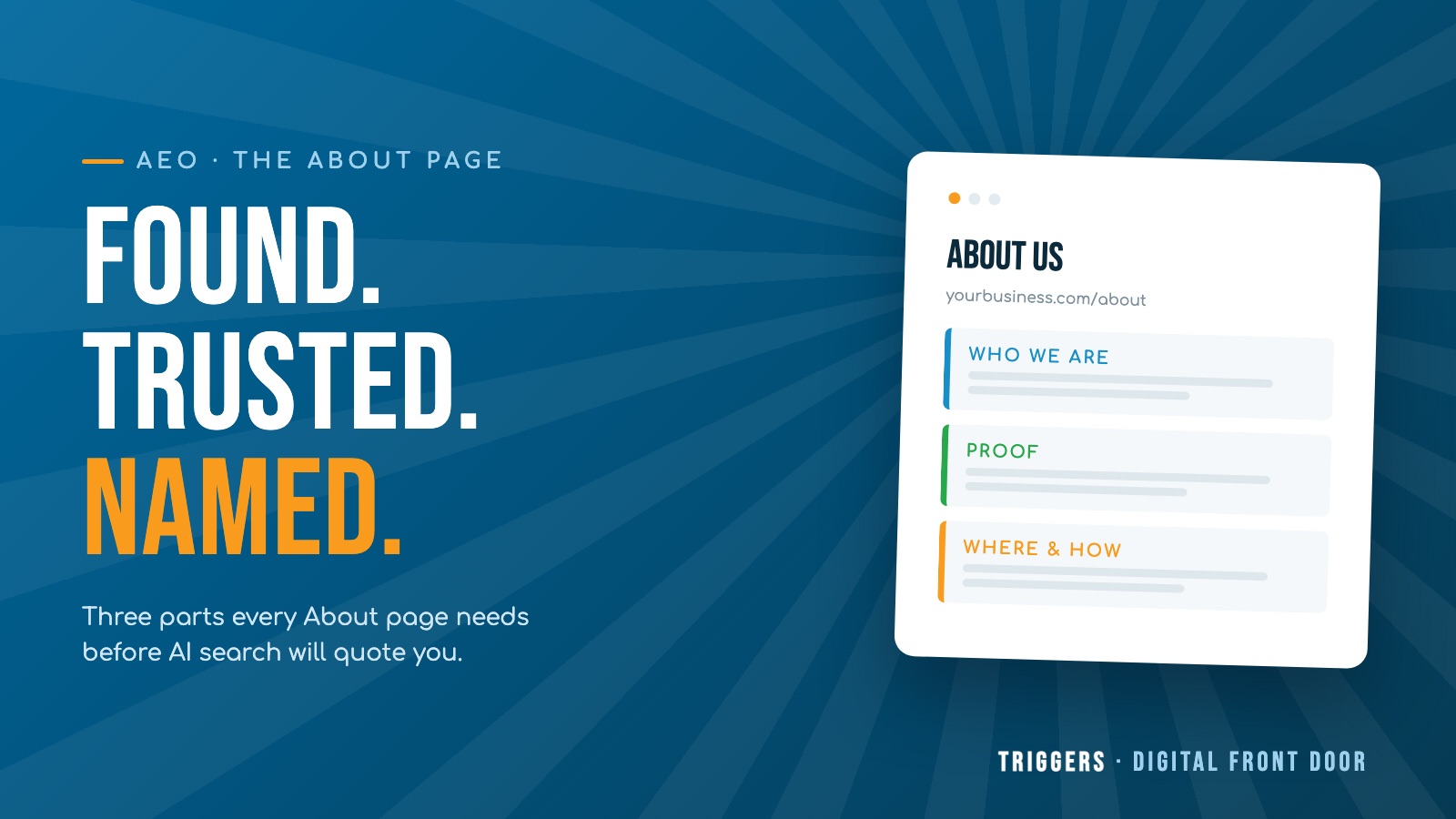
Here is the fix. Do not delete your About page. Rebuild it. One strong page, three clear parts: your story, your team, and why you.
Do not delete the page. Deepen it.
Some people online will tell you to delete your About page and hide it behind a menu that does not even click. Ignore that advice. Your About page is often one of the most visited and most trusted pages on your whole site. It is also the page an AI is most likely to read when it wants to understand your business. Keep it. Keep it clickable. Then fill it with things only you can say.
Break it into three parts.
Part 1: Your story
Not a mission statement. Your actual history.
When did you start. Where. Who was there on day one. What did the first office look like. What changed along the way. Put real dates on it. Add old photos, even the rough ones. People love watching a business grow, and those details are proprietary by definition. No competitor can honestly claim your founding year or your first two employees. That is exactly the kind of specific, checkable fact that AI search understands and repeats back.
A simple timeline works. Year, one line, one photo. That is enough.
Part 2: Meet your team
Give people names, roles, and faces.
Prospects want to know who they will actually work with. A page with real photos, real names, and real titles builds trust in a way a stock image never will. It also helps search engines and AI assistants connect real people to the business, which strengthens how they read you as a credible company. If this feels obvious, good. Most sites still skip it.
Keep this separate from your story so each section has one clear job.
Part 3: Why you
This is where the decision gets made.
Give ten short, hard facts that separate you from the next option. Not feelings. Facts. Years in business. What you actually do, in plain words. Your service area. Certifications and partner badges. Awards. Real results you can stand behind. Anything a buyer could check and a competitor could not honestly copy.
Run every line through one test. If it could sit on a competitor's site without changing a word, cut it. Replace it with something that is only true about you.
Now make it readable by machines
Good content is step one. AI search also reads the structure of the page. Three quick moves:
- Use headings that match how people ask. "Where are you located." "Who is on the team." "How long have you been in business."
- Add schema. Organization schema for the business, and Person schema for each team member. Schema is the label that tells a machine what it is looking at.
- Give AI a plain-text version of your facts. A simple llms.txt file, or a short section written for assistants, makes your key facts easy to lift and quote.
You do not need to be technical to want these. You just need to ask for them.
The checklist
- Keep one About page. Do not delete it or hide it.
- Add a real history with dates and old photos.
- Add a team section with names, roles, and faces.
- List ten hard, checkable reasons to choose you.
- Cut any line a competitor could paste without lying.
- Add Organization and Person schema.
- Give AI a plain-text version of your facts.
Do this and two things happen. Real people trust you faster. And when an AI gets asked who to hire, it has real reasons to name you.
At Triggers Media, this is how we build every Digital Front Door. If you want to see how your own online presence reads to a customer and to AI, get your Digital Front Door Score. We will show you what is working, what is missing, and what to fix first.